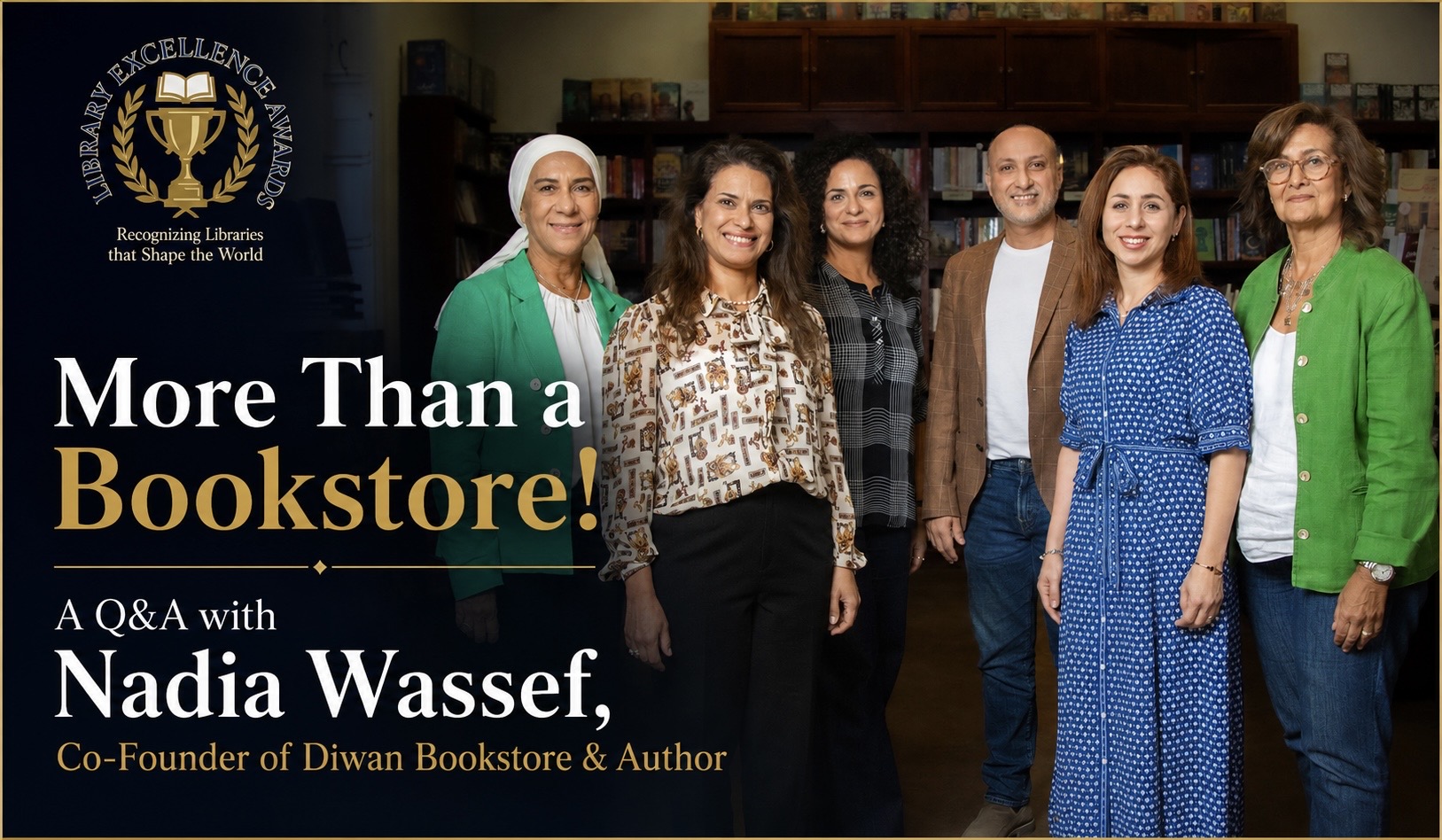
More Than a Bookstore! A Q&A with Nadia Wassef, Co-Founder of Diwan Bookstore & Author
Journalism: Alaa Mohamed
Publisher: Dr. Mahmoud Mansi
“Books are objects, but the culture around books is made of relationships. Excellence lies in how well we nurture those relationships...”
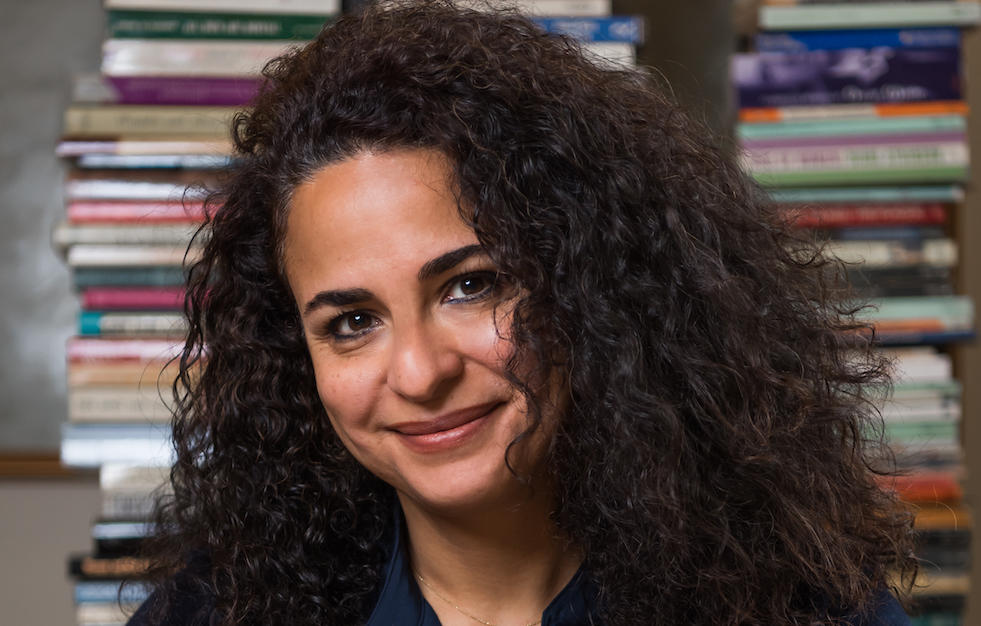
In March 2002, at a time when Egypt’s publishing market offered more challenges than encouragement, Nadia Wassef and her sister Hind took a chance on a different kind of reading experience. What began as a dream to create a space where readers could feel at home became Diwan Bookstore—a name that would help reshape Egypt’s contemporary literary landscape.
More than two decades later, Diwan has evolved into a multidimensional cultural ecosystem. Spanning 12 branches, Diwan Publishing House, Fil Diwan Podcast, and vibrant community events, it continues to preserve the magic of slow, intentional discovery in an increasingly fast-paced digital world.
Beyond her pioneering work with Diwan, Nadia’s journey reflects a lifelong commitment to advocacy, learning, and storytelling. She was named among Forbes’ Most Powerful Women in the Middle East for three consecutive years (2014–2016), recipient of Veuve Clicquot’s Initiative for Economic Development (2011), and honored as Woman of the Year in the “Woman for Women” category (2022), Nadia also holds three master’s degrees from AUC, SOAS, and Birkbeck and is the author of the acclaimed memoir Shelf Life: Chronicles of a Cairo Bookseller. Before entering entrepreneurship, she worked in research and advocacy with the Female Genital Mutilation Taskforce and the Women and Memory Forum.
In this exclusive Library Excellence Awards (LEA) feature, Nadia takes us behind the shelves to explore entrepreneurship, human curation in the age of AI, the complicated relationship between failure and success, and what the bookstore of the future might become.
Diwan’s Board of Directors: Amal Mahmoud, Hind Wassef, Nadia Wassef, Ahmed al Qarmalawi, Layal Rustom, Nihal Schawky.
Link to Nadia Wassef’s Multi-Lingual Books on Amazon
LEA: How about we travel back in time to the year 2002? Yes, the year you fulfilled the dream of co-founding and establishing Diwan in Cairo, Egypt with your sister Hind Wassef. Back then, few people took risks, especially women in this field, what inspired you and your partners to take the leap and move forward with this project?
Nadia Wassef: At the turn of the twenty-first century, Cairo’s cultural scene was experiencing a kind of renaissance. Tremendous creative energy flowed through literature, art, music, film, and design, and we wanted to be part of it. We wanted to build the kind of place we ourselves wanted to spend time in—a bookstore where you could browse, meet people, have coffee, discover something unexpected, and feel that you belonged. Hind was sure others must be looking for the same thing. I also think something else helped us enormously: we were completely ignorant of how difficult it would be. Had we known all the challenges ahead, perhaps we would never have started. Sometimes a certain degree of ignorance is useful to an entrepreneur. It gives you the courage to begin before you can imagine all the reasons you might fail.
LEA: How about we travel further in time, back to when you and your sister Hind were children. How were you raised to grow up to become two accountable daughters, two distinctive authors, two courageous entrepreneurs, forming one beam of light with multiple reflections through Diwan’s entity? What was the impact of your parents?
Nadia Wassef: Our parents belonged to a generation for whom higher education was not necessarily taken for granted, and yet both had an enormous curiosity about the world. Our father was an avid reader and an ardent lover of Arabic. He read newspapers, magazines, history and poetry. Our mother loved the arts. She constantly took us to the theatre, museums, exhibitions and galleries. Whatever she could expose us to, she did. Each of them, in a very different way, planted a seed in us. When we became teenagers and began asking questions about our identities and what it meant to be Egyptian, we went looking for Egypt. And we found her in literature, music, theatre and art. I think that stayed with us. Years later, Diwan became another way of asking that same question: who are we, what stories do we tell about ourselves, and how do we create a space in which those stories can live alongside the stories of the rest of the world?
LEA: Throughout your journey as an entrepreneur with Diwan, I’m sure some things unfolded exactly as you expected, while others turned out even better than you imagined, and perhaps a few came as complete surprises. Tell us about those experiences, and what entrepreneurship in the world of books looks like to you today?
Nadia Wassef: Diwan was its own education. We learnt from setting up the business, from the people who worked with us, from our customers, and from the entire ecosystem surrounding bookselling. We also failed many times, and we learnt the cost of innovation. One thing nobody tells you is that following your dreams and being driven by passion comes at a price. Passion may get a business started, but it does not necessarily keep it alive. We weren’t particularly good with numbers. Today I understand that numbers matter enormously because financial sustainability lets your purpose survive. I also learnt to question assumptions about growth. We live in a world in which scaling is automatically considered a measure of success. Bigger is assumed to mean better. But growth has a cost, and sometimes an entrepreneur must have the courage to ask: Why are we growing? What are we trying to achieve? And what might we lose in the process?
Another assumption I have learnt to question is that founders necessarily need to manage the enterprises they create. The skills it took to launch Diwan are not necessarily the same ones required to nurture and sustain her over time. Part of being a co-founder is knowing when to make room for a different kind of leadership. Today, Diwan has a wonderful CEO, Amal Mahmoud, who is leading the company into its next phase of sustainability.
Today there are extraordinary opportunities for innovation in bookselling, particularly through technology. But I also wonder whether we have become less forgiving of failure. Entrepreneurship requires experimentation, and experimentation requires the possibility of getting things wrong. If there is no room to fail, there is ultimately less room to innovate.
LEA: With the rise of e-commerce platforms, audiobooks, social media, and so many distractions competing for readers’ attention—and at a time when simply staying relevant can feel like an achievement in itself—how have you managed to grow and move forward at this pace?
Nadia Wassef: I would challenge the idea that our pace has been fast. We opened our first bookstore in 2002 and our second in 2007. Then came a period of rapid expansion, followed by the Egyptian revolution, political instability and enormous economic pressure. We lost money and spent years dangerously close to closing. Only much later were we able to catch our breath, restructure and think again about what sustainable growth might look like thanks to Nihal Schawky, one of the original co-founders, and Amal Mahmoud, Diwan’s CEO.
What has kept Diwan relevant is its ability to listen. Our booksellers and our customers educate us every day. They tell us what people are reading, what they are curious about, and how their habits are changing. Without them, Diwan would not be Diwan.
Social media is a double-edged sword, but it has also created extraordinary possibilities for discovery. Writers, readers, publishers and bookstores can speak directly to one another. BookTok alone has demonstrated that younger generations are not necessarily abandoning books; they are simply discovering and talking about them differently. The tools can evolve. The fundamental purpose of the bookstore—discovery, conversation, curation and community—remains constant.
LEA: Before AI, book and novel recommendations often came from the people around us or from librarians. Now, with AI becoming part of our everyday lives, how do you see it influencing readers’ choices and the way they discover what to read?
Nadia Wassef: If used well, AI-driven recommendation engines can enhance discoverability. They can help readers navigate an overwhelming number of titles and lead them to books they might not otherwise encounter. But what I find particularly interesting is that, alongside the current fascination with AI, we are also seeing a counter-movement toward the analogue—particularly among younger people exhausted by living so much of their lives digitally. There is renewed interest in physical books, vinyl, notebooks and spaces where people can simply be together.
An algorithm can tell you, “If you liked this, you may like that.” A bookseller can ask you why you liked it. That distinction matters. AI can assist discovery, but it cannot replace the human encounter at the heart of bookselling. Human beings crave belonging and community. Bookstores are architects of those communities. They bring people together around ideas, stories and curiosity. Technology can support that work, but I don’t believe it can replace it.
LEA: How, as an entrepreneur, have you managed to preserve the spirit of Diwan’s very first branch across all your branches? And as a reader and a writer yourself, how did you manage to create an experience that can actually shape the way readers feel when they step into any of Diwan’s bookstores?
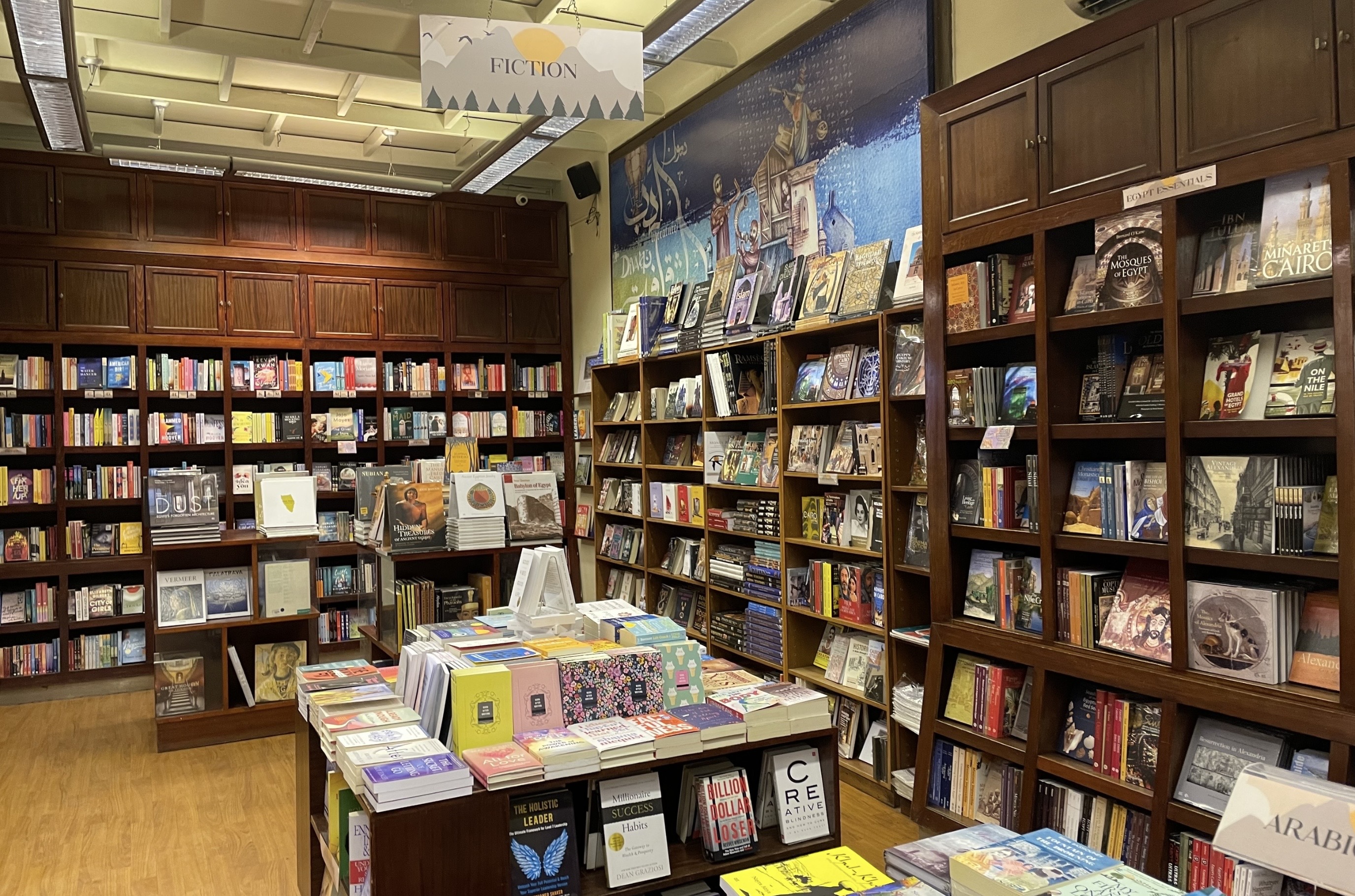
Nadia Wassef: I don’t think you preserve the spirit of a bookstore by reproducing the first branch exactly. A bookstore has to respond to its neighborhood, its customers and the people who work there. Each Diwan has its own personality. What we have tried to preserve instead is a set of values: curiosity, hospitality, curation, conversation and the belief that everybody who enters a bookstore should feel that there is something there for them.
From the beginning, we thought very carefully about the experience of being inside Diwan—not simply the transaction of buying a book. The lighting, the shelves, the café, the music, the way books are displayed and, most importantly, the booksellers themselves all contribute to that experience. As a reader, I have always loved the possibility of serendipity: entering a bookstore looking for one thing and leaving with something you didn’t know you needed. As a writer, I know how extraordinary it is that a book can sit quietly on a shelf until the right reader finds it.
LEA: Over the years Diwan Bookstore has evolved into having its own publishing house, podcast, literary café, and more on the way. Do you consider this as an expansion or evolution? And how did it positively and negatively impact the business?
Nadia Wassef: I think of it much more as an evolution than an expansion. Expansion suggests doing more of the same. Evolution means allowing the original idea to develop into new forms. Diwan began as a bookstore, but even in 2002 we never thought we were simply selling books. We were creating a cultural space around books, ideas and conversation.
Diwan Publishing, led by Ahmed Al-Qarmalawi and Layal Al-Rustom, allows us to participate in creating books, not just selling them. The café extends the conversation. The Fil Diwan Podcast lets us explore the wider creative economy and reach people beyond the bookstore’s walls. Our cultural programming brings writers, artists, thinkers and readers together.
The positive impact is that these activities reinforce one another and make Diwan part of a much larger cultural ecosystem. But there is also a danger. Diversification can dilute your attention and your identity. You can become so excited by everything you could do that you forget what you are good at. The question we continually must ask is not, “What else can Diwan do?” but “Does this belong in the world of Diwan?” If it strengthens our relationship with books, culture, ideas and community, then it is an evolution. If it doesn’t, we probably shouldn’t be doing it.
LEA: The Library Excellence Awards recognizes not only libraries and librarians, but the wider ecosystem that keeps knowledge and reading cultures alive—including bookstores, publishers, literary cafés, authors, artists, and content creators. From your perspective, what should “excellence” really mean when we recognize a bookstore, library, or individual working with books?
Nadia Wassef: For me, excellence in our world cannot simply be measured by sales figures, visitor numbers, followers or the size of a collection. Those things tell us something, but not everything. Excellence is about access, curation, generosity and impact. Does a library make knowledge available to someone who might otherwise be excluded from it? Does a bookstore introduce readers to voices they didn’t know? Does a publisher take risks on stories that need to exist? Does a bookseller listen rather than simply sell?
I also think excellence requires longevity. Anyone can create excitement for a moment. The harder task is to build something that remains meaningful—to keep adapting without abandoning your values. And perhaps most importantly, excellence in the world of books should be measured by what happens beyond the institution itself. Did somebody discover a writer? Did a child become a reader? Did two people who might never otherwise have met begin a conversation? Did an idea travel further because you gave it a home?
Books are objects, but the culture around books is made of relationships. Excellence lies in how well we nurture those relationships.
LEA: Finally, what is your motto that keeps you moving forward without limitations?
Nadia Wassef: I am slightly wary of the idea of moving forward “without limitations.” Limitations exist and sometimes recognizing them is wisdom rather than defeat. I don’t have a motto, but I have a mindset. Diwan has taught me that very little happens in a straight line. You build, you fail, you learn, you change direction, and sometimes you return to where you started with a completely different understanding of why you were there in the first place. Curiosity keeps you open—to people, books, ideas and possibilities. And the willingness to begin again prevents failure from becoming an ending. I think a meaningful life is not one without limitations or failures. It is one in which neither has the final word.
Social Media Links
Diwan Bookstore - Diwan Publishing House - Fil Diwan Podcast - Diwan Book Cafe - Diwan Kids - Linktr